Prompt #001 — Dry Decontamination Decision Matrix for Field Commanders
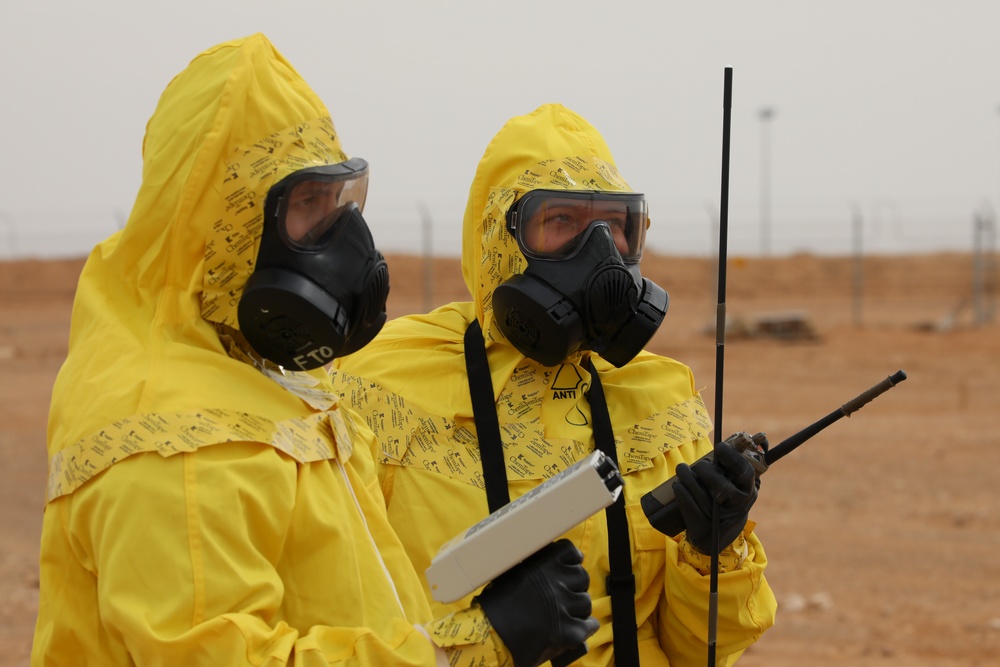
Dry Decontamination Decision Matrix — AI Prompt for Field Commanders
A ready-to-deploy AI prompt template that transforms CBRN decontamination method selection from experience-dependent intuition into a structured, repeatable decision process. Built on NATO ATP-3.8.1 doctrine and validated against real-world operational variables.
Why CBRN Decontamination Needs AI Decision Support
When a CBRN incident occurs, field commanders face a cascade of decisions under extreme time pressure. The most critical among them: which decontamination method to deploy. The wrong choice doesn’t just waste resources — it can spread contamination, damage sensitive equipment, or create secondary hazards that endanger the force. Current doctrine (NATO ATP-3.8.1 Volume I) provides comprehensive guidance, but translating doctrine into real-time decisions requires processing multiple variables simultaneously: contaminant type, ambient temperature, water availability, equipment sensitivity, casualty volume, mission timeline, and environmental constraints. This is precisely where AI excels — and where “Tactical Prompt Engineering” creates a decisive advantage. A well-structured prompt transforms an LLM into a decision-support tool that can synthesize these variables in seconds, presenting commanders with a ranked recommendation matrix rather than forcing them to manually cross-reference tables under stress.The Dry vs. Wet Decontamination Decision Matrix
Before deploying the AI prompt, commanders need to understand the fundamental trade-offs. The following matrix summarizes the key operational variables that drive method selection, drawn from published research and NATO standards:Operational Variable Comparison
| Variable | Dry Decon | Wet Decon | Hybrid |
|---|---|---|---|
| Setup Time | ~5 sec | ~90 sec | ~60 sec |
| Water Required | None | High (300+ L/hr) | Moderate |
| Chemical Agents (liquid) | Effective | Highly Effective | Optimal |
| Biological Agents (particulate) | Limited | Effective | Recommended |
| Radiological (particulate) | Limited | Effective | Recommended |
| Sub-zero Operations | Optimal | Degraded | Feasible |
| Sensitive Equipment | Safe | Risk of Damage | Selective |
| Mass Casualty (50+ pax) | First-line | Follow-up | Sequential |
| Effluent/Runoff Control | No runoff | Containment required | Reduced |
Sources: NATO ATP-3.8.1 Vol I; Hazmat Resource Inc.; PubMed (2025) Scoping Review on Dry Decon Effectiveness
Tactical Decision Flowchart
Copy-Ready AI Prompt: Decontamination Method Selector
The following prompt is engineered for use with Claude, GPT-4, or equivalent LLMs. It embeds doctrinal logic, forces structured output, and includes safety constraints. Replace the[VARIABLE] fields with your operational parameters.
Quick Decision Configurator
Select your operational parameters below to generate a rapid decontamination method recommendation. This client-side tool applies the same decision logic embedded in the prompt template.How to Deploy This Prompt in Operations
Step 1: Pre-load Into Your AI System
Copy the full prompt template above. In your AI system (whether GenAI.mil, a local LLM, or a commercial API), paste it as a system prompt or conversation starter. The role assignment and decision logic constraints ensure consistent behavior across sessions.Step 2: Input Operational Variables
Replace each[VARIABLE] with real-time field data. In a time-critical situation,
even partial data is valuable — the prompt is designed to handle “Unknown” inputs by
defaulting to the most conservative (safest) recommendation.
Step 3: Validate Against Commander’s Judgment
The AI output is decision support, not decision replacement. The field commander retains full authority. Use the AI recommendation as one input among intelligence reports, unit status, and tactical judgment.Why “Dry First” Is the Future of CBRN Decontamination
The defense community has historically defaulted to wet decontamination as the gold standard. However, a growing body of evidence — including a 2025 scoping review published in Disaster Medicine and Public Health Preparedness — suggests that dry decontamination deserves a far more prominent role in operational doctrine, particularly as a first-line response in mass casualty scenarios. The operational math is compelling: dry decontamination achieves initial hazard reduction in approximately 5 seconds per individual, compared to 90 seconds for wet methods. In a mass casualty event with 200+ affected personnel, this time differential translates directly into lives saved and mission continuity preserved. This is precisely why UAM KoreaTech’s CBRN-CADS (Close Air Decontamination Support) technology focuses on high-temperature dry decontamination delivery via unmanned aerial platforms — eliminating the water logistics chain entirely while maintaining decontamination effectiveness against liquid chemical agents.
References & Doctrine Sources
- NATO ATP-3.8.1 Vol I — CBRN Defence on Operations (STANAG 2521)
- Evaluating the Effectiveness of Dry Decontamination Methods for Hazmat Incidents: A Scoping Review (2025), Disaster Medicine and Public Health Preparedness
- Understanding Wet vs Dry Decontamination — Hazmat Resource Inc.
- Dry vs. Wet Decontamination: Which Is Right for the Situation? — FAST-ACT
- Decontamination — Strategies to Protect the Health of Deployed U.S. Forces (NCBI/NAS)
- New Decontamination Protocols in Response to a CBRN Attack — Ouvry CBRN Protective Systems
- DoD Manual 3145.03 — Chemical, Biological, and Radiological (CBR) Contamination Survivability

Park Moojin
CEO, UAM KoreaTech | Tactical Prompt Engineer Military History & Psychology
Architect of CBRN-CADS — an unmanned aerial decontamination system combining high-temperature dry decontamination with autonomous flight. First-author inventor of 21 intellectual property assets (domestic patents, international PCT filings, technology transfers, and trademarks) in airborne gas sterilization and CBRN decontamination. Bridging defense technology and AI to create decision tools that save lives in contaminated environments.

댓글
댓글 쓰기